
Key Takeaways
- One-quarter of Tennessee’s residents are now over the age of 60, and 36% of Tennessee seniors have a functional disability.¹⁴ ¹⁵ For seniors, unpaid family caregivers are the most relied on source of long-term care.¹⁶
- Providing care to family members can have significant economic impacts on caregivers, with 32% of caregivers across the country retiring early or quitting their jobs due to caregiving responsibilities.¹⁷
- One in four Tennesseans act as an unpaid caregiver to family members or friends, with one in three Tennessee caregivers reporting spending over 20 hours a week providing care.¹⁸
- Eleven states include caregiving as part of their comprehensive paid leave programs, and 16 include family caregiving in their paid family and medical leave for state employees.¹⁹
In 2023, the Tennessee legislature established a six-week paid family leave program for most state employees and educators for the birth of a child or adoption placement. This year, the legislature is considering allowing this paid leave to be used for foster placement and caregiving of parents and close family members.
The State of Tennessee and its employees benefit from a six-week paid family leave program.
Parents and children have better health and economic outcomes as a result of paid family leave policies. Mothers with access to paid leave are more likely to return to work, earn higher wages, and progress in their careers, and families are less likely to need public assistance, live in poverty, and have food insecurity.(1),(2),(3) Paid family leave decreases infant mortality and child abuse, improves children’s cognitive development, and increases the likelihood of graduating high school, attending college, and earning higher wages as an adult.(4),(5),(6),(7)
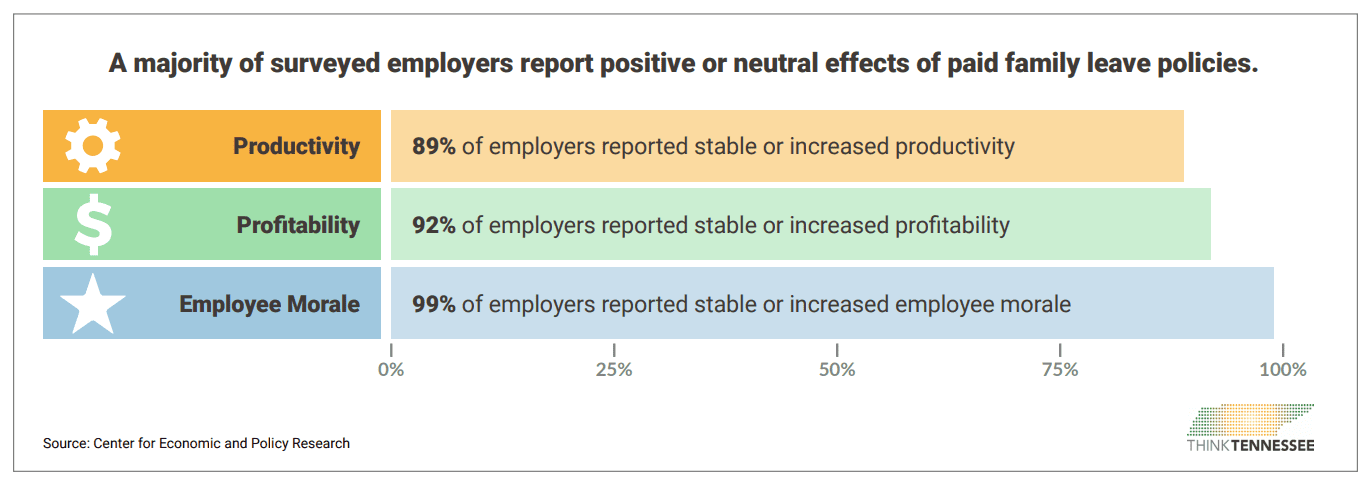
Paid family leave helps recruitment and hiring, reduces employee turnover and hiring costs, and improves morale and productivity. Paid leave reduces turnover, allowing employers to avoid the cost of replacing an employee, which can be up to 40% of their annual salary.(8) A majority of employers with paid leave reported positive or neutral effects on profitability, productivity, and employee morale.(9)
1. The Council of Economic Advisers. (June, 2014.) “The Economics of Paid and Unpaid Leave.”
2. Houser, Linda, Ph.D. and Vartanian, Thomas P., Ph.D. (January, 2012.) National Partnership for Women & Families “Pay Matters: The Positive Economic Impacts of Paid Family Leave for Families, Businesses and the Public”
3. Prenatal-to-3 Policy Impact Center. (n.d.) “Paid Family and Medical Leave Road Map.”